Release date:


Most small business owners know they should be more consistent on social media. The reality is that posts happen sporadically — something gets shared when there's a spare moment, inspiration strikes, or someone remembers it's been two weeks since the last update. Then life gets busy again and another month passes in silence.
This is not a discipline problem. It's a systems problem.
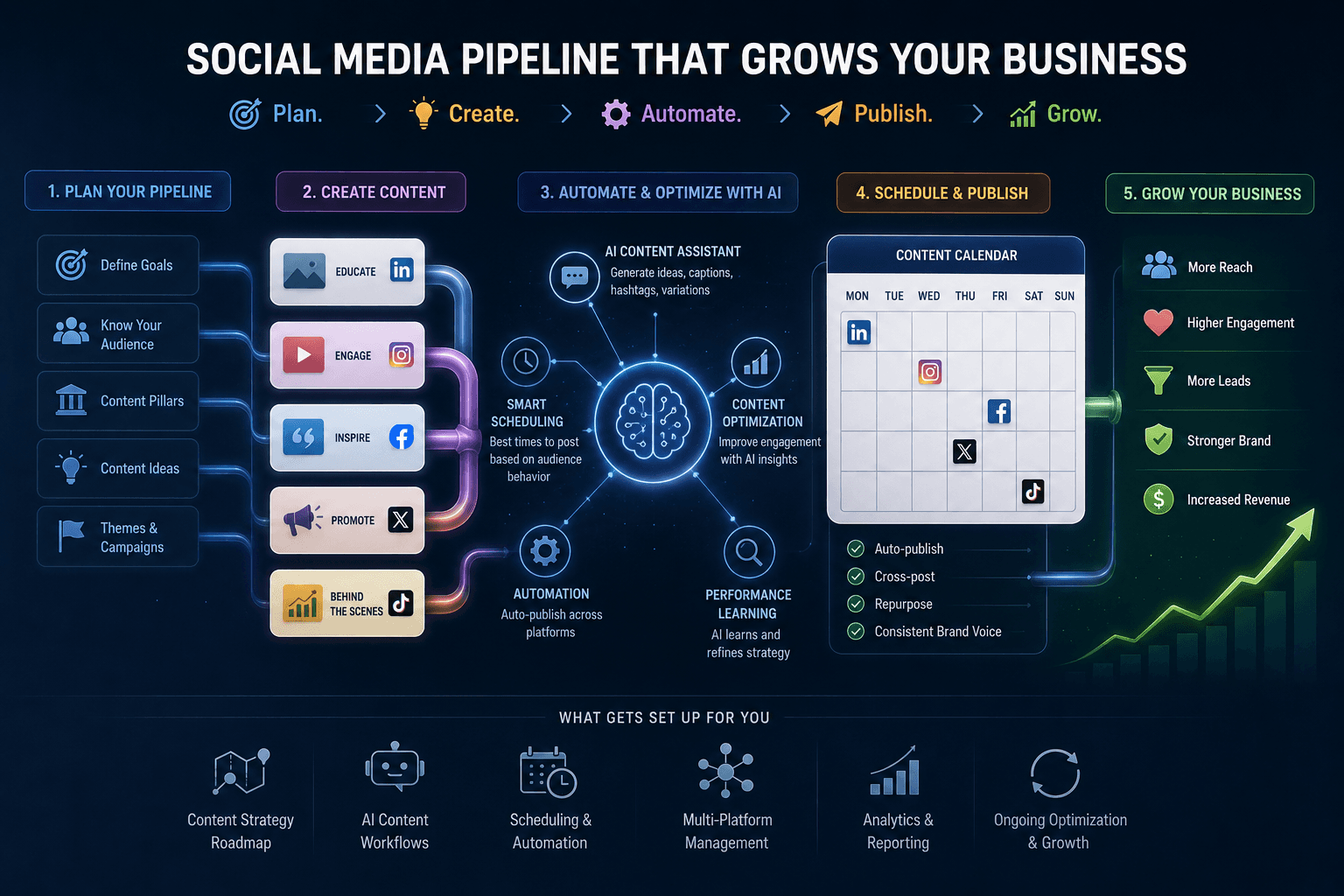
Social media works when it's treated like a pipeline — a structured, deliberate flow of content that moves from idea to published post with minimal friction and maximum consistency. And in 2025, AI and automation have made it genuinely possible for a small business to run that pipeline without a dedicated marketing team.
This article covers how to build a social media content pipeline from scratch, when to post on each platform for an Australian audience, how AI and automation handle the heavy lifting, and exactly what Proteuss can set up for your business.
Why Consistency Is the Only Thing That Matters on Social Media
Before getting into the mechanics, it's worth understanding why consistency is the non-negotiable foundation of any social media strategy.
73% of social media users admit that if a brand fails to post or respond, they will take their business to a more active competitor.
Social platforms reward accounts that post regularly. Their algorithms prioritise content from accounts with consistent publishing histories, meaning irregular posting doesn't just mean fewer posts — it means the posts you do publish reach fewer people.
Companies with a documented content strategy report 46% higher conversion rates than those without one.
Consistency also builds trust. A Sunshine Coast business that shows up in its audience's feed regularly, with relevant and useful content, becomes familiar. Familiarity builds credibility. Credibility drives enquiries. This is the mechanism by which social media generates business — and it requires showing up reliably, not brilliantly once a month.
Lower posting frequency with higher quality content is producing better engagement results compared to constant posting. The goal is not to flood your audience — it's to show up consistently with content that earns their attention.
Step 1: Define Your Content Pillars
A content pipeline starts with content pillars — the three to five core themes your business will consistently post about. Pillars give your social media a coherent identity and make content creation dramatically easier because you're never starting from a blank page.
For a business like Proteuss, content pillars might look like this:
Education — Tips, how-tos, and explainers about AI, automation, and digital transformation for SMBs
Social proof — Client results, case studies, and testimonials
Behind the scenes — How we work, who we are, what a project looks like in practice
Industry insight — Trends, research, and commentary relevant to Sunshine Coast and Brisbane business owners
Direct offer — Services, consultations, and specific calls to action
Every post you create maps to one of these pillars. This makes content planning faster, keeps your messaging coherent across platforms, and ensures your feed isn't a random mix of unrelated content.
A practical guide to content balance is the 80-20 rule: 80% of posts should inform, educate, or entertain your audience, while 20% can promote your products and services directly. Not every post needs to be a sales pitch.
Step 2: Build a Content Calendar
Once you have your pillars, the next step is planning content in advance using a content calendar — a scheduled view of what will be posted, on which platform, on which date.
A content calendar does several things that sporadic posting cannot:
It eliminates the "what do I post today?" problem entirely. It ensures a balanced mix of content types across your pillars. It lets you plan around important dates — local events, industry milestones, seasonal campaigns. It gives you visibility across platforms so nothing goes quiet for weeks at a time.
A social media calendar allows you to easily spot where you're missing a post entirely, or certain types of posts, and ensures every post has a purpose — whether it's building awareness, driving engagement, or supporting a product launch.
For most Sunshine Coast SMBs, a monthly content calendar planned in batches — dedicating a few hours at the start of each month to plan and create content for the full month ahead — is the most sustainable approach. Content is created in one focused session, scheduled to publish automatically, and the business owner is free to focus on delivery for the rest of the month.
Step 3: Know When to Post — Australian Timing by Platform
Timing matters because social media algorithms prioritise content that receives early engagement. A post that generates likes and comments in the first 30–60 minutes gets pushed to more feeds. A post that lands when nobody is looking gets buried.
Here is the current best-practice timing for the Australian market, based on the most recent data:
Best for: B2B businesses, professional services, consultancies, trades targeting commercial clients.
Post between 9am–12pm midweek (Tuesday–Thursday) and 4–6pm. Recommended frequency: 2–3 posts per week.
LinkedIn is the primary platform for Proteuss and most B2B Sunshine Coast businesses. Decision-makers scroll LinkedIn during business hours — mid-morning and the post-lunch window are when professional content gets the most traction.
Best for: Local consumer businesses, trades, health, retail, hospitality — audiences aged 35 and above.
Post between 9–11am, 1–3pm, and evenings 4–8pm, particularly on Thursdays. Recommended frequency: 3–5 posts per week.
Thursday consistently shows the highest peak engagement across most networks for the Australian market. Saturday yields the lowest engagement across almost all platforms.
Best for: Visual businesses — retail, hospitality, health, lifestyle, creative services.
Post weekday evenings 7–9pm, Friday mornings 8–10am, and weekend mornings 9–11am. For feed posts: 3–5 per week. For Reels and Stories: daily if possible.
Around 14 million Australians use Instagram — approximately 63% of eligible users. Instagram is ideal for visual storytelling and brand discovery.
TikTok
Best for: Consumer brands targeting under-40 audiences, high-volume content creators, businesses with strong visual or educational content.
Post evenings between 7–10pm, with a Friday morning spike. Recommended frequency: 1–4 posts per day if aggressive, or 3–5 per week to start.
TikTok's 8.5 million Australian users spend an average of 42 hours a month on the app — more than any other network.
Google Business Profile
Often overlooked but highly valuable for local businesses. A regular post here improves local search visibility and keeps your listing active.
Recommended frequency: At minimum one post per week. Even a short update, an offer, or a recent project photo keeps your profile current in local search results.
Step 4: Use AI to Create Content Faster and Better
This is where the workload equation changes fundamentally for small businesses.
AI is helping nearly 8 out of 10 social media professionals increase their content production speed. Almost three-quarters of businesses using AI for social content have experienced higher engagement. Nearly 4 in 10 SMBs now use AI for marketing, recruiting, or support tasks.
AI tools can now handle the most time-consuming parts of social media content creation:
Drafting captions and posts. Given a topic, a tone, and a platform, AI generates multiple caption options in seconds. A business owner reviews and selects rather than writing from scratch.
Repurposing content across platforms. A blog post becomes a LinkedIn article summary, three Instagram captions, a Facebook post, and a Google Business update — all from the same source material, adapted for each platform's tone and format automatically.
Generating content ideas. Based on your pillars, your industry, and current trends, AI surfaces content ideas you may not have considered — turning a content brainstorm from an hour-long exercise into a five-minute one.
Writing for your voice. With a clear brand tone guide, AI tools can be trained to produce content that sounds like your business — not generic AI output.
Creating visual content. Tools like Canva's AI features, Adobe Firefly, and dedicated social media design platforms generate on-brand graphics, carousels, and visual assets without a graphic designer.
The result: a business that once spent four to six hours a week on social media content can reduce that to under an hour — with better output and more consistency.
Step 5: Automate Publishing and Scheduling
Creating content in advance is only half the system. Automation handles the publishing — ensuring posts go out at the right time on the right platform without anyone needing to manually press publish.
Scheduling and automation platforms used for this include:
Buffer — Straightforward scheduling across all major platforms. Clean interface, affordable for SMBs, strong analytics on what's performing.
Hootsuite — More comprehensive, suited to businesses managing multiple platforms and needing team workflows, approval processes, and detailed reporting.
Later — Strong visual calendar interface, particularly popular for Instagram-first strategies.
Meta Business Suite — Free native scheduling for Facebook and Instagram. Limited to Meta platforms but zero additional cost.
Zapier / Make — Workflow automation tools that connect platforms together. For example: a new blog post is published → AI automatically generates a social caption → the post is scheduled in Buffer → a notification is sent to the team. All without manual intervention.
The combination of AI content creation and automated scheduling means a business can batch-produce a month's worth of content in a few hours, schedule it all, and have social media running in the background while the team focuses on delivering for clients.
How Social Media Consistently Grows Your Business
For Sunshine Coast and Brisbane SMBs, the business case for a properly managed social media pipeline comes down to four mechanisms:
Visibility and awareness. The Sunshine Coast business landscape is increasingly competitive. A business that shows up consistently in its audience's feed occupies mental real estate. When that person needs what you offer — or knows someone who does — your business is the one they think of.
Credibility and trust. An active, professional social presence signals that a business is real, active, and worth engaging with. A profile that hasn't posted in six months sends the opposite signal — particularly for service businesses where trust is the primary purchase driver.
Lead generation. Content that educates and demonstrates expertise generates inbound enquiries — people who have read your content, understand what you do, and come to you pre-qualified. This is significantly more efficient than cold outreach.
Referral amplification. On the Sunshine Coast, referrals drive a significant share of business. Social media extends the reach of every referral — a happy client mentions you, someone visits your profile, and consistent content confirms you're the right choice.
Search and discoverability. LinkedIn content, in particular, is indexed by search engines. Google Business posts influence local search ranking. A consistent content pipeline improves your findability beyond just your website.
What Proteuss Sets Up for Your Business
This is where strategy meets execution. Understanding what a social media pipeline should look like is one thing — having it built, configured, and running with minimal ongoing effort from you is another.
Here is specifically what Proteuss designs and implements for Sunshine Coast and Brisbane SMBs:
1. Social Media Strategy and Content Pillar Development
Before any tool is configured, we map your business — your audience, your goals, your competitive position, and your voice. We define your content pillars, your platform priorities, and the content mix that fits your business and your capacity. This is the foundation that everything else is built on.
2. Content Calendar Design
We build a structured content calendar tailored to your business — monthly or quarterly depending on your preference — with topics mapped to pillars, post types planned across platforms, and space for timely or reactive content alongside scheduled evergreen posts.
3. AI Content Workflow Setup
We configure an AI-assisted content creation workflow specific to your business. This includes building the brand voice and tone guide that feeds into AI prompts, setting up templates for each content type and platform, and establishing a repeatable process for generating a month of content in a single focused session — whether that session is run by you, a team member, or us.
4. Scheduling and Automation Platform Configuration
We set up and configure your chosen scheduling platform — Buffer, Hootsuite, Later, or Meta Business Suite — connect all relevant accounts, establish the optimal posting schedule for your audience and platforms, and integrate automation workflows so content moves from creation to scheduled without manual steps.
5. Repurposing Automation
We build workflows that automatically repurpose your existing content — blog posts, case studies, client testimonials — into social media-ready formats across platforms. One piece of content becomes five posts. A client result becomes a LinkedIn update, an Instagram carousel, and a Google Business post, automatically.
6. Reporting and Optimisation
We configure reporting dashboards that show you what's working — which posts are driving engagement, which platforms are generating the most reach, and what content types your specific audience responds to. This data feeds back into content planning, so the pipeline improves over time rather than running on assumptions.
7. Training and Handover
If you want to manage the pipeline yourself after setup, we train you and your team to run it confidently. If you'd prefer ongoing management, we handle it for you. Most clients start with a managed setup and transition to self-management once the system is running smoothly.
What This Looks Like in Practice: A Sunshine Coast Example
Consider a Sunshine Coast consulting firm that currently posts to LinkedIn inconsistently — something goes up when the director has time, which means roughly two posts a month. Engagement is low, the profile feels inactive, and no business has ever come directly from social media.
After a Proteuss engagement:
Five content pillars are defined, covering education, client results, industry insight, team culture, and direct offer
A monthly content calendar is built with 12 LinkedIn posts, 8 Facebook posts, and 4 Google Business updates planned per month
An AI content workflow is set up — the director spends 90 minutes at the start of each month reviewing and approving AI-drafted posts rather than writing from scratch
All posts are scheduled automatically via Buffer to publish at optimal times
A repurposing workflow means every blog post published on the website automatically generates three social posts
Within 90 days, posting frequency has gone from two posts per month to twelve on LinkedIn alone. Within six months, inbound enquiries from LinkedIn have become a consistent and growing source of new business.
The director's time investment: 90 minutes per month.
Getting Started
Building a social media pipeline is not a one-day project, but it is also not as complex as most SMB owners assume. The foundation — strategy, pillars, calendar, and tools — can be in place within two to three weeks. The AI and automation workflows that make it sustainable take another week or two to configure and test.
The result is a system that runs consistently in the background, keeps your business visible, and generates genuine business value — without social media consuming hours of your week.
If your business is invisible on social media, or showing up sporadically without a clear strategy, a conversation with Proteuss is the right starting point. We'll assess what you currently have, what your audience and platforms warrant, and give you an honest recommendation on what would make the most difference.
Book a free 30-minute consultation at proteuss.com.au
Quick Reference: Posting Guide for Australian SMBs
Platform | Best Days | Best Times (AEST) | Recommended Frequency |
|---|---|---|---|
Tue–Thu | 9am–12pm, 4–6pm | 2–3 posts/week | |
Mon–Thu | 9–11am, 1–3pm, 4–8pm | 3–5 posts/week | |
Weekdays + Fri morning | 7–9pm weekdays, 9–11am weekends | 3–5 posts/week + daily Stories | |
TikTok | Mon–Fri | 7–10pm, Friday mornings | 3–5 posts/week to start |
Google Business | Weekly | Any | 1 post/week minimum |
Written by the team at Proteuss — AI and Digital Transformation consultants serving the Sunshine Coast and Brisbane. Visit proteuss.com.au