Release date:


Introduction
Most small business owners are experts in what they do. They understand their product, their customers, and their industry. What they often don't have is a clear, documented picture of how their business actually operates — the processes, the systems, the dependencies, the gaps, and the bottlenecks.
That gap between "how we think the business works" and "how it actually works" is one of the most common and costly problems in growing businesses. It leads to poor technology decisions, failed system implementations, staff confusion, inconsistent customer experiences, and missed opportunities.
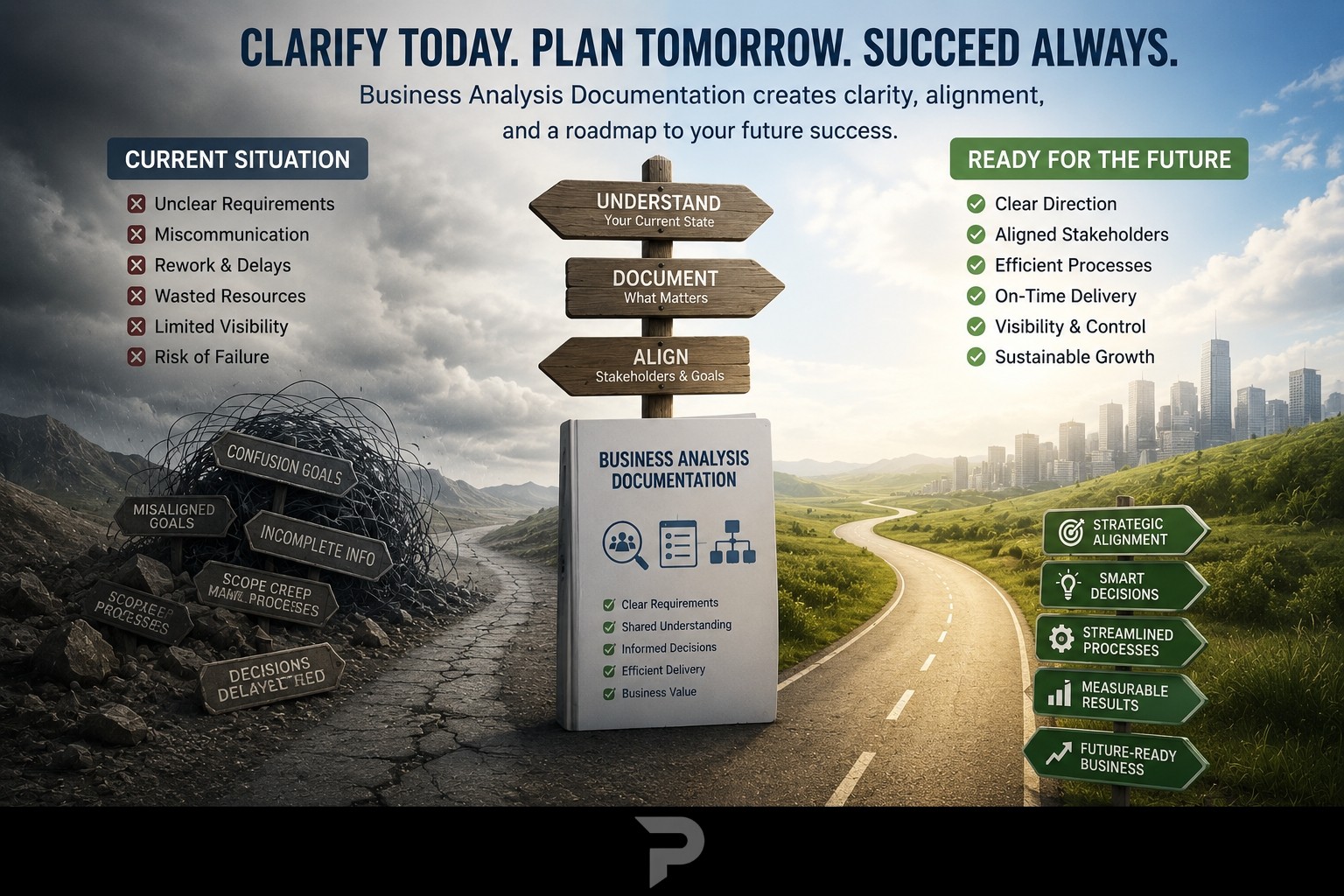
Business analysis documentation is how you close that gap. It's not a bureaucratic exercise. It's a deliberate process of understanding your business in enough detail that you can make better decisions — about technology, people, processes, and growth — with confidence instead of guesswork.
This article explains what business analysis documentation is, what it includes, why it matters, and what it makes possible. It's aimed at Sunshine Coast and Brisbane SMBs who are growing, changing systems, or simply trying to understand their operations better before making their next move.
What Is Business Analysis Documentation?
Business analysis documentation is a structured set of documents that capture how a business currently operates, what it needs, where the problems are, and what the future should look like.
It's the difference between:
"We think leads come in through the website, someone calls them back, and we send a quote"
and:
"Here is every step in the lead-to-quote process, who owns each step, what system is used at each stage, what happens when the assigned person is unavailable, what information is required before a quote can be issued, and where the process currently breaks down."
The first version is what most business owners can describe from memory. The second version is what business analysis documentation actually produces. And the difference between those two levels of understanding is enormous when it comes to making meaningful improvements.
It doesn't require a large business or a dedicated team. Some of the most valuable business analysis work happens in growing SMBs that are about to invest in new technology, scale their team, or restructure how they operate.
Why Most Businesses Skip It — and What That Costs Them
Business analysis documentation feels like overhead. It takes time, it requires bringing people together to map out things that "everyone already knows," and the output is a set of documents rather than a new product or a visible result.
So most businesses skip it. They buy software before understanding their processes. They hire staff before documenting what those staff are supposed to do. They attempt to change how things work without first agreeing on how things currently work.
The consequences are well documented.
62% of small business digital transformations fail because companies buy technology before understanding their process gaps. A proper readiness assessment prevents the majority of implementation failures.
The pattern is consistent across industries and business sizes. A business identifies a problem — slow quoting, inconsistent service delivery, data living in too many places — and jumps straight to a technology solution. The implementation struggles because the vendor or implementer doesn't have a clear picture of the actual requirements. The system goes live with critical gaps. The team works around it. The problem persists.
Business analysis documentation is what breaks that cycle. It ensures that before any solution is chosen or implemented, there is genuine clarity about the problem, the current state, the requirements, and what success actually looks like.
What Business Analysis Documentation Reveals
Before getting into the specific document types, it's worth understanding what this process surfaces — because for most SMBs, the findings are revealing in ways that go well beyond "here is a document."
Hidden inefficiencies. Processes that work fine at low volume become expensive at high volume. Documentation surfaces these before they become crises. A step that takes five minutes per transaction seems inconsequential until you realise it happens 200 times a week.
Knowledge concentrated in people. In most small businesses, critical operational knowledge lives in one or two people's heads. When that person is on leave, sick, or leaves the business, that knowledge walks out the door. Documentation distributes that knowledge across the organisation.
System mismatches. Many businesses use systems that made sense at an earlier stage but no longer fit how the business operates. Documentation makes this visible and quantifiable, rather than leaving it as a vague feeling that "things could run better."
Requirement clarity before technology decisions. When you know exactly what your business needs, you can evaluate technology options with specificity rather than relying on vendor demos and feature lists.
A baseline for improvement. You cannot measure whether something has improved if you haven't documented what it looked like before. Business analysis documentation creates the baseline.
Real-World Scenarios Where Documentation Makes the Difference
Scenario 1: The Growing Trades Business
A plumbing business on the Sunshine Coast has grown from three to eighteen staff over four years. Job management is running on a combination of a whiteboard, a basic scheduling app, and the owner's memory. A new job management system is being considered.
Without documentation, the system is selected based on a demo, configured generically, and the team reverts to the old way of working within three months because the system doesn't match how jobs actually flow through the business.
With documentation — specifically a current-state process map, a requirements document, and a gap analysis — the business can evaluate systems against specific requirements, configure the chosen system to match real workflows, and train staff against documented processes rather than informal habit.
The investment in documentation takes two weeks. It prevents a failed six-month implementation that costs tens of thousands of dollars.
Scenario 2: The Professional Services Firm Scaling Its Team
A small accounting firm in Maroochydore is bringing on three new staff members to handle growth. The partners can answer most questions from experience, but there is no documented way of doing anything — how client files are named, how reviews are structured, how deadlines are tracked, or how new clients are onboarded.
New staff spend weeks learning by osmosis, make mistakes that experienced staff would not make, and receive inconsistent guidance because different partners do things differently.
Business analysis documentation — specifically standard operating procedures, process maps, and a stakeholder and role register — means new staff have a structured onboarding path, the business operates consistently regardless of who is doing the work, and the partners can identify where process differences are creating risk.
Scenario 3: The Retailer Preparing for a System Migration
A retail business with two locations is planning to migrate from its legacy point-of-sale system to a cloud-based platform. The project is scoped at three months.
Without documentation, the migration team discovers mid-project that the business has custom pricing rules for specific customer groups, a returns process that doesn't map cleanly to the new system, and reporting requirements that nobody flagged during the initial scoping. The project runs six months over time and significantly over budget.
With a requirements document and an as-is process map completed before vendor selection, the business can validate that the chosen platform handles every requirement, flag exceptions early, and configure the new system correctly from the start.
Scenario 4: The Business Using Analysis to Identify Where AI Can Help
A healthcare administration office is considering where AI and automation could reduce manual work. Without documented processes, it's difficult to know which tasks are high-volume, repetitive, and therefore strong candidates for automation — and which tasks require human judgement and should stay manual.
Business analysis documentation — specifically process maps and a time-and-volume analysis — makes this visible. It turns a vague question ("could AI help us?") into a specific answer ("these four processes account for 22 hours of manual work per week, follow consistent rules, and are strong automation candidates; these three processes involve clinical judgement and should remain with staff").
A digital transformation maturity assessment enables businesses to evaluate their existing infrastructure, employee skills, and operational processes — identifying gaps and providing actionable insights to drive strategic decisions.
The Core Business Analysis Documents Explained
Different situations call for different documents. Here is a breakdown of the core document types, what each one contains, and when it is most useful.
1. As-Is Process Map (Current State Documentation)
What it is: A visual representation of how a business process currently works — the steps, the people involved, the systems used, the decision points, and the handoffs between people or teams.
What it captures:
Every step in the process from trigger to completion
Who is responsible at each step
What system or tool is used
What information is needed to proceed
Where decisions are made and what the options are
Where the process commonly breaks down or slows down
When it's most valuable: Before any process change, system implementation, or team restructure. Also valuable when onboarding new staff or identifying automation opportunities.
What it makes possible: A shared, objective picture of how things currently work — which is the essential starting point for any meaningful improvement.
2. To-Be Process Map (Future State Documentation)
What it is: The same style of document as the as-is map, but representing how the process should work after a proposed change is implemented.
What it captures:
The improved or redesigned process flow
Changes in ownership or responsibility
New systems or tools and how they fit
Steps that are eliminated, automated, or restructured
The intended outcomes of the new process
When it's most valuable: During system selection and implementation, process redesign projects, and when making the business case for change.
What it makes possible: A concrete, communicable picture of where the business is heading — so stakeholders, staff, and implementation partners are aligned on the goal before work begins.
3. Business Requirements Document (BRD)
What it is: A formal document that defines what a business needs from a system, process, or solution — written from the business perspective, not a technical one.
What it captures:
The business problem or opportunity being addressed
The objectives the solution must achieve
Specific functional requirements (what the system must do)
Non-functional requirements (performance, security, usability standards)
Constraints and assumptions
What is explicitly out of scope
When it's most valuable: Before selecting or procuring any technology, and as the governing document throughout an implementation project.
What it makes possible: Clear evaluation criteria for technology options, a reference point for vendor discussions, and a basis for testing that the delivered solution actually meets business needs.
4. Gap Analysis Document
What it is: A structured comparison between the current state and the desired future state, identifying the specific gaps that need to be addressed.
What it captures:
What the business currently has or does (people, process, technology)
What the business needs to have or do to meet its goals
The specific gaps between those two states
A prioritisation of which gaps are most critical
Recommended actions to address each gap
When it's most valuable: During strategic planning, before technology investment decisions, and when assessing whether an existing system can meet growing needs.
What it makes possible: A prioritised, evidence-based action plan rather than a list of vague improvements. It answers "where exactly are we falling short, and what needs to change first?"
5. Stakeholder Register and RACI Matrix
What it is: A document that identifies everyone with an interest in a process or project, defines their role, and clarifies who is Responsible, Accountable, Consulted, and Informed (RACI) for each decision or activity.
What it captures:
All stakeholders — internal and external — relevant to the process or project
Each stakeholder's interests, concerns, and level of influence
For each key decision or activity: who does it (Responsible), who owns it (Accountable), who needs to weigh in (Consulted), and who needs to know the outcome (Informed)
When it's most valuable: At the start of any project involving multiple people or teams, and when process ownership is unclear or contested.
What it makes possible: Elimination of the two most common causes of project delays — decisions being made by the wrong people, and the right people not being consulted until it's too late.
6. Standard Operating Procedures (SOPs)
What it is: Step-by-step written instructions for how a specific task or process should be performed, written clearly enough that a capable person with no prior experience could follow them.
What it captures:
The purpose of the procedure
Who it applies to
Step-by-step instructions in plain language
Decision points and what to do in each case
Common errors and how to avoid them
References to relevant systems, templates, or tools
When it's most valuable: Onboarding new staff, ensuring consistency across a growing team, preparing for business continuity, and before any process is delegated or outsourced.
What it makes possible: Consistent delivery regardless of who is performing the task. This is the document that lets a business scale without the owner or a key person being involved in everything.
7. SWOT and Current State Summary
What it is: A high-level assessment of the business's current position — its internal strengths and weaknesses, and the external opportunities and threats it faces.
What it captures:
Internal strengths: what the business does well
Internal weaknesses: where the business underperforms or carries risk
External opportunities: market trends, technology, or changes the business could capitalise on
External threats: competition, regulation, economic conditions, or disruptions to watch
When it's most valuable: During strategic planning, before significant investment decisions, and when leadership teams need a shared understanding of where the business stands.
What it makes possible: Strategic decisions grounded in evidence rather than optimism. A SWOT analysis surfaces uncomfortable truths as well as genuine opportunities.
8. Data and Systems Inventory
What it is: A comprehensive map of all the systems, tools, and data sources the business uses — how they connect, what data they hold, who uses them, and how reliable they are.
What it captures:
All software, platforms, and tools in use
What data each system holds and who owns it
How systems connect or exchange data (and where they don't)
Known limitations, duplication issues, or reliability concerns
Licencing, cost, and contract status
When it's most valuable: Before any digital transformation or system consolidation project, and when assessing whether current systems can support future growth.
What it makes possible: Informed technology decisions. Without this document, businesses routinely underestimate integration complexity, pay for duplicate capabilities, or miss critical dependencies when changing systems.
The Relationship Between Documentation and Future Readiness
There is a direct relationship between having current, accurate business analysis documentation and a business's ability to move quickly and confidently when opportunities or challenges arise.
A structured readiness assessment uses system audits, documentation reviews, stakeholder interviews, and surveys to benchmark current maturity levels, identify gaps and risks, and develop a practical roadmap with sequenced initiatives — connecting digital investments to measurable business results.
Consider what becomes possible when your business has solid documentation in place:
Technology decisions are faster and better. When a vendor asks "what are your requirements?" you have an answer. When a new platform is evaluated, you can assess it against documented needs rather than impressions from a demo.
New staff get up to speed faster. Onboarding moves from weeks of shadowing to structured learning against documented processes. Consistency improves. Supervision requirements decrease.
Scaling doesn't break things. Growth is one of the most common causes of operational breakdown in small businesses. Documented processes scale in ways that informal habits do not.
AI and automation implementation succeeds. As AI tools become more accessible for SMBs, the businesses that benefit most are those who understand their processes well enough to know which parts are suitable for automation. You cannot automate what you haven't documented.
Due diligence is straightforward. Whether you're seeking investment, entering a partnership, or eventually looking at an exit, having documented processes and systems is a significant indicator of business maturity and reduces risk for any party evaluating the business.
How Long Does Business Analysis Documentation Take?
The scope varies with the complexity and size of the business, but here are realistic timeframes for a Sunshine Coast or Brisbane SMB:
Initial current-state process mapping (3–5 core processes): 1–2 weeks
Full business requirements document (for a specific system or project): 2–3 weeks
Gap analysis (against a specific future state): 1–2 weeks
Complete SOP library (across all core functions): 4–8 weeks depending on business complexity
Full business analysis package (current state, requirements, gap analysis, stakeholder register, SWOT, data and systems inventory): 6–10 weeks for a small to medium business
These are working timeframes, not just calendar time. The process involves workshops with your team, review cycles, and sign-off from the right people. It requires genuine engagement from business leadership — not just delegation to a consultant.
Done properly, the documentation produced in this timeframe will be referenced and updated for years, not filed and forgotten.
A Note on Documentation That Stays Relevant
The value of business analysis documentation degrades rapidly if it isn't maintained. A process map that reflects how things worked two years ago is worse than no process map — because it creates false confidence.
Good business analysis practice includes building in regular review cycles — at minimum annually for core documents, and whenever a significant process or system change occurs. The goal is living documentation that reflects the current reality of the business, not a one-off project that dates immediately.
How Proteuss Approaches Business Analysis for Sunshine Coast SMBs
At Proteuss, business analysis documentation is the foundation of every engagement we undertake. Before we recommend a technology, design an automation, or implement a system, we invest time in understanding how the business actually works — not how it's assumed to work.
We've seen too many well-intentioned technology investments fail because the business and the solution were never properly aligned. Documentation is how we prevent that. It's also how we ensure that when a project is complete, the business has something durable — a set of documents that remain useful long after the engagement ends.
If your business is growing, changing systems, considering AI or automation, or simply trying to understand itself better before making the next move, a business analysis engagement is often the most valuable starting point.
Book a free 30-minute conversation with the Proteuss team at proteuss.com.au — we'll give you an honest assessment of what documentation would be most valuable for where your business is right now.
Summary: What Business Analysis Documentation Gives You
Document | What It Answers |
|---|---|
As-Is Process Map | How does our business actually work right now? |
To-Be Process Map | What should the future look like, specifically? |
Business Requirements Document | What exactly do we need from a solution? |
Gap Analysis | Where are we falling short and what needs to change? |
Stakeholder Register / RACI | Who owns what, and who needs to be involved? |
Standard Operating Procedures | How should this be done, every time, by anyone? |
SWOT / Current State Summary | Where do we stand strategically right now? |
Data and Systems Inventory | What technology do we have, and how does it all connect? |
Written by the team at Proteuss — AI and Digital Transformation consultants serving the Sunshine Coast and Brisbane. Visit proteuss.com.au